The ideas behind Atlas
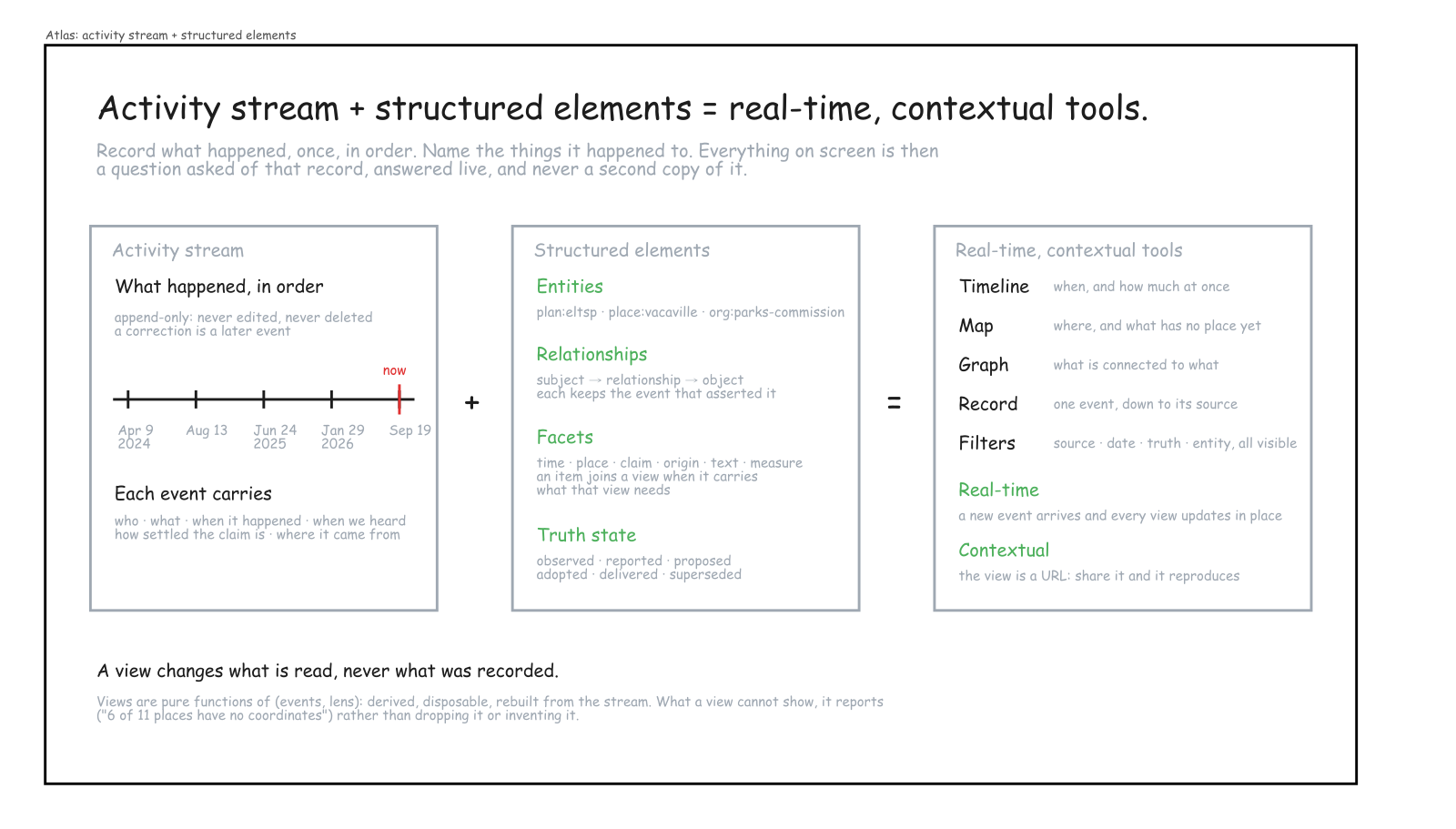
Activity stream + structured elements = real-time, contextual tools.
Record what happened, once, in order. Name the things it happened to. Everything on screen is then a question asked of that record, answered live. It is never a second copy of it.
Where it comes from
Atlas started from two wants.
- Better interfaces for The Public Record — for anyone who wants to know what their government decided, and why
- Better tools for public decision-makers — for the people who have to decide, with the record in front of them
They are the same problem seen from two chairs. The record exists, it is public, and it is very hard to use.
What it is reaching for
Situational awareness, at a higher level than any one document gives. Not only what happened, but what it touches, how sure anyone is, and who is looking at it from where.
- relations, said out loud — what connects to what is part of the information, conveyed explicitly, not left for each reader to work out alone
- a single source of truth — one record, so everybody is on the same page, including about what is still disputed
- perspectives made explicit — which sources, which dates, which axes: the way you are looking is on the screen, and travels with the link
The third is the one that changes conversations. Most disagreement about public matters is partly a disagreement about what each person is looking at, and that part usually goes unsaid. When the record is shared and each perspective on it is visible, people can talk about how they are seeing as well as what they see. That is meta-communication, and it is the level Atlas wants to raise.
A single source of truth is not a single opinion. The record holds what was asserted, by whom, and how settled it is. Being on the same page means reading the same record, not reaching the same conclusion.
The trouble with how The Public Record arrives
A city's decisions reach the public as documents. A staff report, an agenda, a plan, a spreadsheet of payments. Each one is a snapshot, and each is published somewhere different.
So the questions a resident has are hard to answer. What changed, and when? Who said so, and how sure are they? Is this a proposal, a decision, or something already built? What else is this connected to?
A decision-maker has the same questions, the night before a vote, with a four-hundred-page packet. What did we already adopt that this touches? What was promised, and was it delivered? What is still only a claim? The answers are in the record. Nothing puts them in front of the person deciding.
Record what happened, once
Atlas keeps one thing: a stream of events, in order. A plan was proposed. A commission adopted it. A payment was made. A resident asked a question.
The stream is only ever added to. Nothing in it is edited and nothing is deleted. When something turns out to be wrong, the correction is a new event that points at the old one. The mistake stays visible, and so does who fixed it.
Name the things it happened to
Events on their own are a diary. They become useful when they name what they are about.
- entities — the plan, the park, the commission, the person
- relationships — this plan is funded by that budget line, and here is the event that says so
- facets — the parts an event may carry: a time, a place, a claim, an origin, a measure
- truth state — observed, reported, proposed, adopted, delivered, superseded
That is the whole structure. There is no separate database of parks or plans to keep in step with the record. A park is whatever the events say about it.
Every view is a question
The timeline asks when. The map asks where. The graph asks what is connected to what. The record asks what one event says, down to the page it came from.
Each is worked out fresh from the stream, and any of them could be thrown away and rebuilt. That is the rule the rest depends on: a view changes what is read, never what was recorded.
It also means a new kind of view costs very little. If an event carries a place, it shows up on the map. If it does not, the map says how many it could not place, rather than quietly leaving them out.
Say how you know
Every event carries how settled it is. Something we saw directly is not the same as something a source reported. A proposal is not an adoption, and an adoption is not a finished park. Atlas shows that difference on every row instead of flattening it into "news".
Every event also carries where it came from: the document, the section, a fingerprint of the original. You can always walk back to the source.
Atlas can offer a plain-language explanation of a record, written by a language model. It is labelled as that, it is shown and not stored, and it never becomes part of the record. The record is what people and sources assert. A paraphrase is neither.
Filters you can see
The page always shows the whole: how many events there are, across what dates. Each filter then visibly narrows it, by source, by date, by truth state, by entity. What a filter removes stays on screen, greyed, rather than vanishing. You should never have to wonder how you arrived at what you are looking at.
The whole view lives in the address bar. A link carries your perspective: what you selected, every filter, how the axes were set. Send it to someone and they are asked the same question of the same record. So a perspective is something you can hand over, compare and argue with, not something hidden behind a screenshot.
People add, they do not overwrite
A reader can respond to any event with an observation, a question, a correction or a source. Each response is its own event, with its own author, beside the thing it is about. A question stays open until another event answers it. A correction disputes the original without replacing it.
This is where the two wants meet. Residents, staff and decision-makers read the same record and add to the same record. A better interface for the public and a better tool for the dais turn out to be one thing, looked at by different people. They stay in one loop, and no one has to own the loop for it to work.
Where it is now
Atlas runs today on a small demonstration record of one city's growth-area plan. The sources are fixtures, not live feeds. The ideas above are the parts that are built. Connecting real sources is the work ahead.